
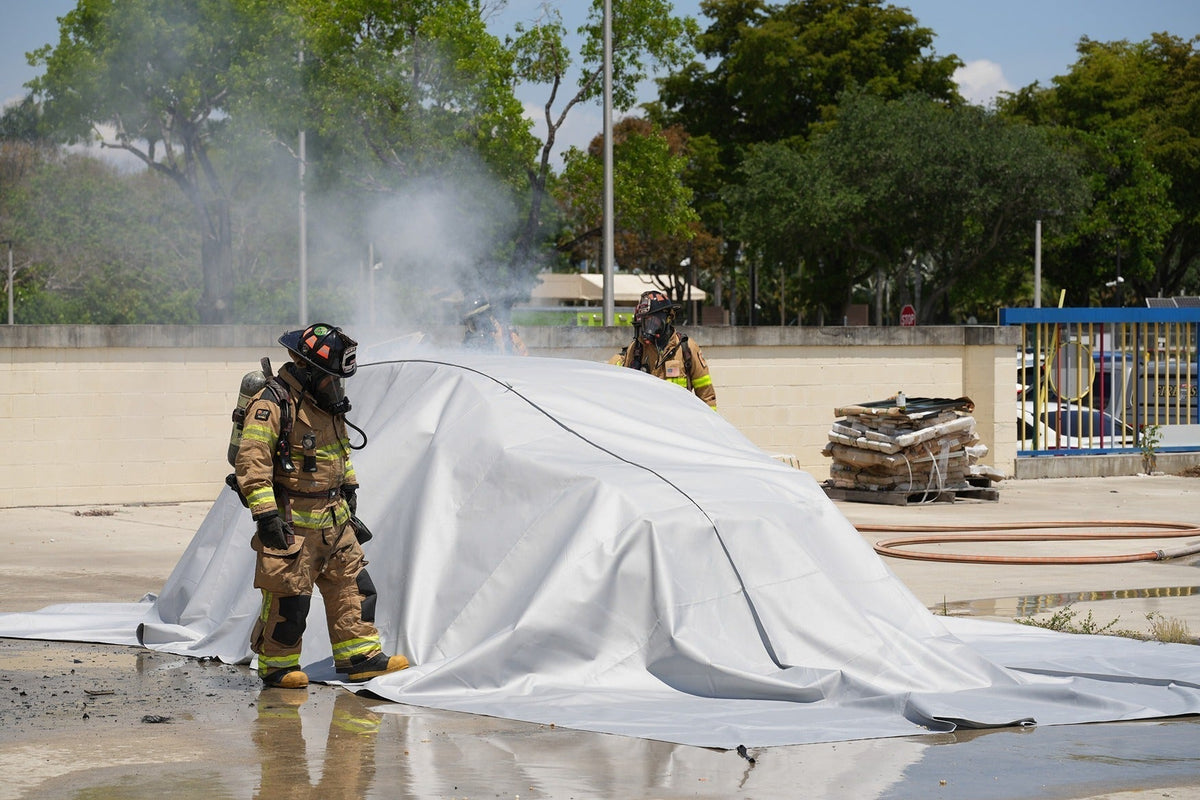
Article Summary: EV fire blankets are designed to contain flames, debris, smoke, and toxic gases—not stop the thermal runaway reaction inside a lithium-ion battery. Certifications such as EN 13501-1, NFPA 701, EN 1869, and DIN 91489 provide useful information about fire performance, but they do not necessarily prove how a blanket will perform during a real EV fire. When choosing an EV fire blanket, consumers should also consider real-world live burn testing, product quality, construction, and proper sizing rather than relying solely on certification claims.
Table of Contents
- The Purpose of EV Fire Suppression Tools and Why Certifications Matter
- Understanding Fire Efficiency Testing: EN 13501-1, NFPA 701, EN 1869, and DIN 91489
- Beyond the Lab Tests
- Finding the Right EV Fire Blanket for You
The Purpose of EV Fire Suppression Tools and Why Certifications Matter
When searching for an EV fire blanket, it can be difficult to determine how effective a particular fire blanket is between product reviews, fancy marketing lingo, and a slew of letters and numbers tied to safety certifications. We can’t speak for other companies, but we can speak to the certifications Li-Fire’s EV Fire Blanket has received and walk you through what they mean. In this blog, we’ll break down four important certifications, so you can better understand what these credentials mean and how they apply to the EV fire suppression tools you’re considering. The credentials are: EN 13501-1, NFPA 701, EN 1869, and DIN 91489.
The first thing I tell people is that none of these standards mean a battery fire blanket stops thermal runaway. It does not. Once thermal runaway begins inside a lithium-ion battery, it cannot be stopped, and the damaged cell must burn itself out. So, fire blankets do not stop these chemical reactions from happening. At Li-Fire, we have never sold our products claiming to stop thermal runaway, and we don’t think anybody in this industry should.
Even though thermal runaway cannot be stopped, fire suppression tools still play an important role in lithium battery fires because they are designed to contain the flame and prevent the spread of debris, smoke, and toxic gases. Our EV Fire Blankets are designed for parking garages, dealerships, body shops, warehouses, ships, and other environments, helping to keep people and property as safe as possible in the event of a lithium battery fire.
Understanding Fire Efficiency Testing: EN 13501-1, NFPA 701, EN 1869, and DIN 91489
EN 13501-1 is a European reaction-to-fire classification system. It looks at how a material contributes to fire and also includes ratings for smoke and flaming droplets. Li-Fire has an A2-s1,d0 classification. In plain English, that means very limited contribution to fire, low smoke production, and no flaming droplets under the conditions of that test.
NFPA 701 is another test that shows up constantly in this market. It deals with flame propagation in textiles and films. In my opinion, as a consumer and fire safety expert, I want to know how a fabric behaves around flame, so there is value in this test. At the same time, I wouldn't put much weight on NFPA 701 by itself when evaluating a product for a large battery fire, because the test simply doesn't recreate an EV thermal runaway event.
EN 1869 is the European standard most people associate with traditional fire blankets. It was built around much smaller fires and portable fire blankets, not a full-size electric vehicle with a large battery pack underneath it. Again, as a fire safety expert, I believe that this test is important, but consumers shouldn’t see this certification and automatically assume that it proves a fire blanket is sufficient in an EV fire event.
DIN 91489 is, in my opinion, the gold standard for EV fire blanket testing. This test is exclusively aimed at the EV application. It's a specialized technical standard from Germany that sets quality, safety, and performance requirements for battery fire blankets used to contain electric vehicle (EV) and lithium-ion battery fires.
While all of these tests provide good baseline information about the fabric in fire blankets, they don’t explain how the blankets will perform over a burning vehicle in a real-world scenario. Those are two different questions, and I think the distinction gets lost in marketing. For that reason, Li-Fire has conducted multiple live fire demonstrations with fire departments and Fortune 500 companies. Check out one of our live burn demos here.
Beyond the Lab Tests
Questions To Ask Yourself
When comparing our testing with other companies, I start with a very basic question: did they actually complete a real-world test? Did they actually burn an electric vehicle? What did the real-world test show, not just the brochure? Those details matter more than a row of logos at the bottom of a product page.
Furthermore, it’s important to determine how long the material was exposed to high heat in each lab test. Was it five or thirty seconds? Several minutes? Did it keep its strength afterward? How does that translate from a lab sample to the real world?
Other Factors: Product Quality, Size, and Live Burn Testing
Quality: I always look at a product from the standpoint of how somebody actually deploys it. A great lab test number doesn’t help if a handle tears, a seam fails, or the device is so awkward that people can't deploy it properly. At Li-Fire, the fabric is the foundation for every blanket we make, but a blanket is more than a piece of fabric. The weave pattern, seam locations, thread type, and handle size all matter when it comes to effective fire suppression.
Size: Choosing the proper size fire blanket for your electric vehicle can make a big difference in the effectiveness of your fire blanket. Sometimes people focus on the footprint of the car and forget that the blanket must cover the roof, sides, and back down to the ground. On a tall SUV, pickup, or van, that eats up material quickly. If the blanket doesn’t touch the ground and you have gaps around the vehicle, that means you aren’t getting proper coverage.
This is also why one-size-fits-all claims can be very misleading. A blanket that works great on a car won’t be the right choice for a full-size pickup truck or van. The application has to drive the size.
Live Burn: The other thing to ask a manufacturer is whether they have ever tested the finished product in the kind of event being marketed. There is a big difference between showing a fabric certificate and showing what happens when deployed during an actual battery fire.
Finding the Right EV Fire Blanket for You
Understanding EV fire blanket standards is paramount for consumers looking to protect themselves from the risks of a lithium battery fire. However, I would never make a purchase based on a certification list alone and don’t recommend that you do either. When analyzing test reports, make sure you’re also considering how the tests were done. Ask what the product is supposed to do and, just as importantly, what the company says it cannot do.
Always remember a battery fire blanket is a containment tool, not an extinguisher. While that’s not as dramatic as saying a fire blanket “puts out” a battery fire, it's the truth. When used properly, these products can be the difference between a small inconvenience and a catastrophic disaster. Just make sure you buy a fire blanket that will perform and provide maximum protection.
If you have questions about finding the right EV fire blanket, what specific certifications mean, and what you should be looking for, Li-Fire is here to help. Talk with our team to get your lithium battery fire questions answered.
0 comentarios